Las Vegas Review-Journal crime reporter Antonio Planas talks about a major "murder mystery" article he wrote for the newspaper. The piece, which was a year in the making before it was published on page A1 Sunday, Nov. 18, 2012, focuses on murder suspect Greg Wallen Jr. While he's facing trial for the cold case murder of a young girl in Las Vegas, a mother in neighboring California believes he's also linked to an even colder case -- the unsolved death of her daughter in 1985, when Wallen was only 12 years old. Planas talks to NAHJ Nevada's Michelle Rindels about the in-depth piece, and what it means to him and his career.
Tuesday, November 20, 2012
Las Vegas Review-Journal Reporter Antonio Planas: On Writing a Murder Mystery
Las Vegas Review-Journal crime reporter Antonio Planas talks about a major "murder mystery" article he wrote for the newspaper. The piece, which was a year in the making before it was published on page A1 Sunday, Nov. 18, 2012, focuses on murder suspect Greg Wallen Jr. While he's facing trial for the cold case murder of a young girl in Las Vegas, a mother in neighboring California believes he's also linked to an even colder case -- the unsolved death of her daughter in 1985, when Wallen was only 12 years old. Planas talks to NAHJ Nevada's Michelle Rindels about the in-depth piece, and what it means to him and his career.

Tuesday, October 23, 2012
Member of the Week: Michelle Rindels
1. Where do you currently work and what's your role
there?
I work for the Associated Press bureau in Las Vegas.
My title is breaking news staffer; I show up to work at 6 a.m. and spend the
day writing short stories (think briefs or readers for broadcasters) about
whatever’s going on in Nevada and Utah. If the story requires a lot more
reporting, I hand it off to my co-workers in Vegas, Carson City, Reno or Salt
Lake City. But I feel like my most important role is helping set the agenda for
the day. I spend the first part of my shift scouring news outlets in both
states and sorting out the important stuff that has broader implications and
impact, from the stuff our small staff can skip. I pitch those stories to my
supervisors, and I feel I’ve accomplished my purpose when they take my
suggestions and the rest of the staff can start their day reporting without
getting bogged down in trivial things.
2. When did you come to Las Vegas? Where were you before?
Where did you go to school?
I came to Las Vegas in July 2011 after spending a few
months covering the Nevada Legislature for the AP and before that, working for
a newspaper in a small town in northern California. I went to school at Biola
University, a small, private Christian college about 15 minutes from
Disneyland.
3. What's your dream job or big career goal? I’d love
to stay with the AP, wherever that might take me, and be an expert on my beat.
I love reporting on cross-cultural issues, religion and the economy.
4. Tell us a little about your ethnic background. My
last name is German, and I’m also Swedish, English, Czechoslovakian, etc. (some
would call this a “European mutt,” but I think that term does a disservice to
how unique each of those different European ethnic roots are). I’m also a
quarter Mexican. My grandma is from the D.F. and immigrated to the U.S. when
she married my American grandpa at age 28. Spanish was my mom’s first language,
and while she didn’t teach it to us as much I wish she had, my brothers and I
have always known the full range of “tu” commands: “parate!” “sientate”
“callate!” From a young age, I longed to understand the secret language my
grandma and mom spoke amongst themselves. I started studying Spanish with a computer
program at 10 or 11, took all the classes I could in high school, majored in
Spanish in college (along with journalism), and studied abroad in Costa Rica.
Probably because of my amazing abuelita, Spanish has always been the language
of love to me, and the Hispanic culture has always felt like home.
5. What inspired you to become a journalist or public
relations professional? I think it was a coloring contest. My hometown
newspaper, The Manteca Bulletin, published kids’ art every Sunday and gave prizes
for the best drawings. I was a prolific contributor because I loved to draw and
loved the prizes I’d get. But the contest ended up hooking me to newspapers
overall. I started with the kids’ page and by looking through the colorful ads
that came every Sunday, but progressed to the real stories and started reading
the paper every day as a third grader. The people behind the familiar bylines
were my heroes. I considered other careers growing up, but realized I wanted to
pursue journalism when I became a senior in high school and worked on the
school paper. I think I was inspired by how powerful the media can be -- how it
brings hidden things to light and can stir entire communities to action.
6. What is the most difficult story you've had to
cover? What did you learn from the experience? I think politics in general can
be difficult to cover. You must constantly keep your guard up to ensure you’re
not being “used” as a tool by some campaign, and you’ve got to keep your
personal biases at bay. Covering the Legislature, you have to be shrewd -- hold
people accountable, not let them get away with vagueness or half-truths,
understand the many motivations that play into every vote. It’s not easy,
especially for people with personalities like mine, but I think one thing that
keeps you on track is understanding that you’re an advocate for the public and
you can only serve them best if you extract the truth from powerful people.

7. Of all the stories you've covered, which is your
favorite and why? Shortly after Michael Jackson’s death, I did a story about
all the Jackson impersonators that suddenly cropped up in Las Vegas. It was fun
to capture that very Vegas-ish mix of sincere love for the King of Pop and
opportunism. This story also stands out because one of the Michael Jackson
impersonators tried to ask me out, in full costume!
8. If you could interview any person, dead or alive,
who would it be and why? I recently read a book about Dietrich Bonhoeffer, a
German pastor who joined the resistance against Hitler during World War II and
ended up being executed for doing what he knew was right. I was so struck by
his courage and his ability to stand up to all his “reasonable” compatriots who
didn’t want to rock the boat by challenging the dictator. I hope that I could
be someone who’s able to recognize the right thing to do even when there are
vast tides going in the opposite direction.
9. What do you see as the biggest challenge facing
journalism or PR today? With smaller staffs, it’s becoming harder to
investigate the things that need investigating. We’re stretched so thin and
rely a lot on news releases, making the industry more vulnerable to the “spin”
people are pitching. It’s critical that journalism finds ways to be
economically viable, so we can get more people out there holding people
accountable.
10. Why did you join NAHJ Nevada and what do you hope
to get out of it? I was invited to NAHJ by my former AP co-worker, Cristina
Silva. At first I didn’t see the point in joining, but after six months, I
realize what an incredible community of journalists it has fostered. I love the
camaraderie we have, and I’m excited to see how we can help cultivate the next
generation of journalists that’s passionate about smart, sensitive coverage of
our diverse community.
11. If you were going to introduce us to the most
important people in your life, who would they be? I’d want you to meet my
incredible immediate family, including my two brothers (I’m the middle child of
three). But I really want you to meet my adorable grandma, who’s the most
loving, generous, witty 84-year-old you’ll ever know. She’s all the more cute
because she’s 4 feet 10 inches tall, has a thick Mexican accent, and named her
walker “Charlie.”
12. Tell us a fun fact we probably don't know about
you. The name of the town I grew up in is Spanish for “lard.”

Monday, September 24, 2012
PIO-Journalist Social at the Springs Preserve

NAHJ-Nevada wants to send a big thank all those who joined us for a PIO-journalist social at the Springs Preserve Monday, Sept. 24. Nearly 40 people came for an evening of networking and discussing how public agency spokespeople and journalists can work together more effectively.
Attendees included PIOs from
- Clark County
- City of Las Vegas
- North Las Vegas Fire Department
- Mesquite Police
- Nevada Highway Patrol
- Nevada Department of Corrections
- Nevada Department of Transportation
- Clark County School District
- UNLV
- Bureau of Reclamation
- Southern Nevada Water District
... and reporters from
- KTNV Channel 13
- KSNV Channel 3
- Univision Channel 15
- Las Vegas Review-Journal
- El Tiempo newspaper
- El Mundo newspaper
- Associated Press
We hope to to host similar mixers in the future. If you couldn't come this time, we hope to see you at our next event! For updates and group news, please follow us on Twitter (@NAHJNevada) or like us on Facebook.
Tuesday, September 11, 2012
Recap: Informational Meeting at Univision Nevada Studio
 By Luz Gray
Our
informational meeting at the Noticias Univision Nevada studios on Sept. 10 was a great
experience. We not only had the opportunity to meet more colleagues, but also
exchanged ideas that no doubt will help consolidate our group little by little.
Michelle Rindels, NAHJ - Nevada President and an Associated Press reporter, introduced our
leadership team, talked about the general purpose of the national organization, the history of Nevada chapter, and our goals and plans for future events. She
also explained about the role of Marco Villarreal, our secretary/ treasurer and reporter for Channel 13 Action News.
Annette Raveneau, our publicity coordinator and communications director at Know Your
Care Nevada, spoke about our founder, Associated Press reporter Cristina Silva.
She recapped “The Language of Immigration” panel we hosted a few months
ago at the Mexican Consulate and the “Night at the Museum” with Jon Ralston event we had at the Hispanic Museum of Nevada
in the Boulevard Mall on July.
Noticias Univision
Nevada Reporter and NAHJ Graphic Designer Eden Soto Alva shared some
details about the UNITY convention held at Mandalay Bay resort in August.
One of our
more exciting upcoming events is a PIO-Journalist Social we will have on Sept. 24 at Springs Preserve. Michelle Booth, our recruitment officer and a PR associate at Ramirez
Group, explained how important it is for us to host this type of event, since it's the first time in recent memory something like this
has happened in Las Vegas.
“We are
taking advantage of Facebook and Twitter. Our community needs to know who we
are what we do and a little bit more of who is behind those stories they read,
see or listen to,” said Journalist Luz Gray, who handles NAHJ - Nevada's social media and is production manager at Univision Radio Las Vegas.
Our vice president and El Tiempo Editor Hernando Amaya detailed the process of how to
join our national organization, reviewed the types of memberships and emphasized the importance of
being part of our local group.

Everybody
contributed ideas and suggestions for the future of NAHJ - Nevada during our
informational meeting. Most importantly, we all agreed on the importance of
encouraging our colleagues in Spanish media to join our group.
It's very easy
to become a member, and the national organization has temporarily reduced the price of joining to $50 per year (it was $75). Sign up today:
1. Go to http://nahj.org/
2. Click on
the words "Join/Renew"
3. Click
"Create Account" and follow the directions.

Sunday, September 2, 2012
Member of the Week
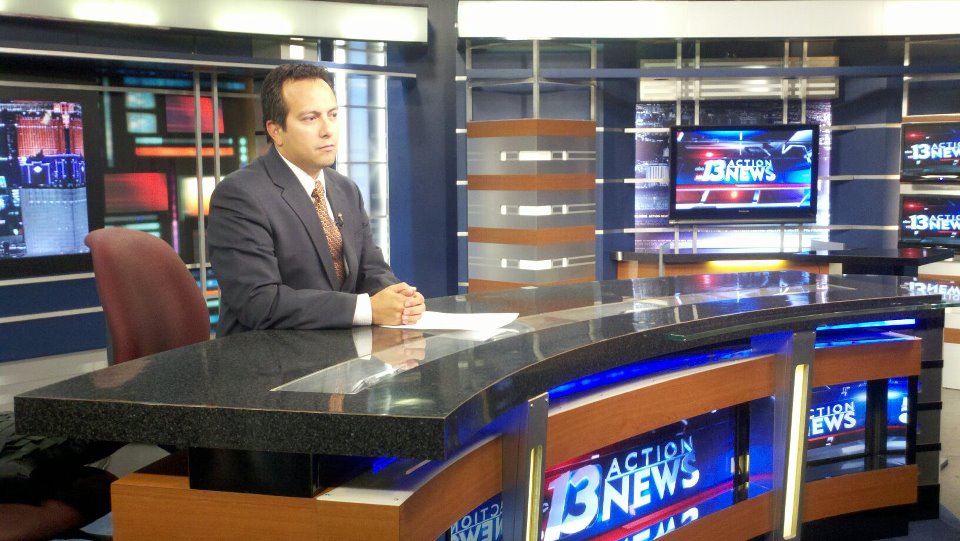
Marco Villarreal
1. Where do you currently work and what's your role
there?
I am a reporter at Channel 13 Action News KTNV.
2. When did you come to Las Vegas? Where were you
before? Where did you go to school?
I came to Las Vegas in February of 2010. I moved here
from the state capitol of Florida, Tallahassee. I studied Broadcast Journalism
at Brigham Young University.
3. What's your dream job or big career goal?
I suppose ultimately I would like to one day work for
a network. I know that sounds cliché, but I feel that is one of the few places
that still allow for journalists to travel the world, tell new and exciting
stories, and document history. I would like to know that I can play with the
“big boys.” I would like to end up in a community that allows me to tell their
stories and serve them.
4. Tell us a little about your ethnic background.
I grew up in a home diverse in culture. My dad was
from Argentina, and my mom from Mexico. I also grew up in the USA. I like to
say that I am half Argentine, half Mexican, and 100% All American! Thanksgiving
was fun at my house. Usually on our table we had the traditional turkey and
stuffing, along with tortillas, frijoles, arroz, and for dessert pan dulce con
un mate cocido. (hot Argentine herbal type tea)
5. What inspired you to become a journalist?
Growing up there was two truths in my house; the
scriptures and the news. My mother always taught us to believe in God and
listen to the weather forecaster. The news was always on with Jorge Ramos
taking us on a trip around the world, showing us pictures and introducing us to
people I would never meet. The only time the news was not on was Saturday, but
that’s because we were all watching Don Francisco! When I was in college
someone mentioned that Spanish language media was the only market still growing
strong. I wanted to use my Spanish and for the first time thought that I might
do what I had seen so many reporters do growing up. I began studying that
profession, enjoyed it, and it turned out I was decent at something for the
first time in my life besides goofing off!
6. What is the most difficult story you've had to
cover? What did
you learn from the experience?
I think the toughest story I have had to cover is the
economy here in Las Vegas. I never realized how bad the recession hit until I
moved here. For the first six months I felt so guilty when I spoke with
families losing their homes because mom and dad couldn’t find a job. I truly
thought I had taken the last job in Southern Nevada. I have had to do stories
that break down why the banks won’t do more to help people losing their homes.
I have had to talk to people who learned the hard way the consequences that
come from living outside your means, and others who did nothing wrong; they
were just a casualty of a bad economy. I never saw Las Vegas in all it’s glory
5to 7 years ago when “everything people touched turned to gold.” I’m glad I
didn’t. I think it would have made it even harder to see the suffering in our
community.
7. Of all the stories you've covered, which is your
favorite and why?
I think one of my favorite stories is that of Rosie
the Riveter here in Las Vegas. I met a lady who sews blankets for a local
charity. She spends hours putting these blankets together so that other’s in
her community can have something that was made with love. This woman is close
to 90-years-old and says she got her spirit of service from her time as a Rosie
the Riveter. She used to work in a factory that put planes together during
World War II. Ever since then she volunteered her time at hospitals, and to her
local community. Even at her age she had more energy, spirit, and positivity
than anyone I’ve ever met. After our interview with her she made sure my
photographer and I did not leave with out giving her a hug and leaving with
some of her homemade jam.
8. If you could interview any person, dead or alive,
who would it be and why?
I plead the 5th on this one. Like I
explained above, sometimes the best interviews come from the people you least
expect and are often overlooked.
9. What do you see as the biggest challenge facing
journalism or PR today?
Sensationalism and close mindedness. We live in a
world where we all fight to capture the attention of viewers and readers. By
hoping to shock people and grab their attention, we lose those who are focused
and waiting for knowledge of the world around them. By going after the
outrageous stories or people, the scandals and crimes, we forget to bring
people the information they need to shape the community they live in. I also
believe we live in a time where people don’t want to hear the facts and make up
their minds. People have already made up their minds and only want to hear what
appeases them. I think it is sad when we tell people what they want to hear
instead of what they need to hear.
10. Why did you join NAHJ Nevada and what do you hope
to get out of it? I enjoy NAHJ because it allows me to communicate with other
journalists and media professionals. It’s good for morale, for networking, and
for the delicious food and music that is prevalent at many of our meetings!
11. If you were going to introduce us to the most
important people in your life, who would they be?
My family. I would not be where I am without their
support and love. Oh, and my dog Jimmer. He always wants to meet new people. J
12. Tell us a fun fact we probably don't know about
you.
I am a Grammy Award winner…sort of. My senior year of
high school the choir I was in won a Grammy. That counts right?


Saturday, September 1, 2012
Breakfast at Hash House A Go Go

Sunday, August 19, 2012
Happy Hour at Ra Sushi

Here's our list of objectives for the club. It's a work in progress, so let us know in the comments if you think something should be added, changed or subtracted.
NAHJ Nevada Goals:
- Build positive relationships and lifelong friendships among the press corps
- Strengthen the ties between the press, public relations professionals, and Hispanic community leaders so our coverage will be more complete
- Promote development of technical journalistic skills through workshops, conferences, and mentorships. Help facilitate this growth with scholarships and fellowships.
- Advance the careers of our members by promoting their work and publicizing job opportunities. Advance diverse hires by connecting with employers.
- Identifying and addressing issues inherent in English and Spanish media outlets (ethics, stereotypes, quality control)
Subscribe to:
Posts (Atom)